Showing posts with label Gastropoda. Show all posts

Monday, December 3, 2012

Publications - update 4

The ariophantid Hemiplecta belerang sp. nov. from South Sumatra is described in this paper. It is compared with its closest congeners, from which it is geographically and reproductively isolated.

Hemiplecta belerang Cilia & Abbas, 2012 - holotype specimen 

Hemiplecta belerang, live animal photographed in type locality

Reference:

Cilia, D. P. & Abbas, J., 2012. A new species of Hemiplecta Albers, 1850 (Gastropoda, Pulmonata, Ariophantidae) from Sumatra, Indonesia. Biodiversity Journal, 3 (2): 137-144. accessible here

Thursday, November 29, 2012

Publications - update 2

The invasive Melanoides tuberculata (Müller, 1774), a freshwater and brackish water snail, is reported from Mosta and Baħrija in Malta. Shells from these populations are morphologically distinct from a population at Salini first recorded in 1981.

Shells of Melanoides tuberculata from Malta - specimens from Baħrija, Mosta and Salini.

Reference:

Cilia, D. P., Sciberras A. & Sciberras J., 2012. Two non-indigenous populations of Melanoides tuberculata (Müller, 1774) (Gastropoda, Cerithioidea) in Malta. MalaCo, 9: 4 pp. accessible here

Wednesday, November 28, 2012

Publications - update 1

A new species of olivid neogastropod from West Java, Agaronia johnabbasi sp. nov., is described according to conchological characters. It is distinguished from congeners by means of its distinctive morphology and colouration.

Agaronia johnabbasi Cilia, 2012 (left specimen). For comparison - Agaronia johnkochi Voskuil, 1990 (middle specimen) and Agaronia nebulosa (Lamarck, 1811) (right specimen). All specimens are from West Java (Pangandaran Bay).

Reference:

Cilia, D. P., 2012. A new Javan species of Agaronia Gray, 1839 (Neogastropoda, Olividae). Novapex, 13 (1): 33-36.

Tuesday, November 27, 2012

New Sicilian landsnails

Two new species of land snails from Sicily have been described in the latest issue of Biodiversity Journal. The first species is a clausiliid in the genus which is this blog's namesake - Muticaria brancatoi Colomba, Reitano, Liberto, Giglio, Gregorini & Sparacio, 2012, from south-eastern Sicily. It is the fourth described Muticaria and is a perfect illustration of the genetic complexity exhibited by island endemisms.

Muticaria brancatoi Colomba, Reitano, Liberto, Giglio, Gregorini & Sparacio, 2012

The second species is a slug, Tandonia marinellii Liberto, Colomba, Giglio & Sparacio, 2012. The description is included in a paper which also mentions the first finds of Rumina saharica Pallary, 1901 from Sicily, for which specimens collected by myself from the island of Marettimo were examined.

Tandonia marinellii Liberto, Colomba, Giglio & Sparacio, 2012


The island of Marettimo, from where R. saharica has been recorded

References:

Colomba, M. S., Reitano, A., Liberto, F., Giglio, S., Gregorini, A. & Sparacio, I., 2012. Additional data on the genus Muticaria Lindholm, 1925 with description of a new species (Gastropoda Pulmonata Clausiliidae). Biodiversity Journal, 3: 251-258. accessible here

Liberto, F., Giglio, S., Colomba, M. S. & Sparacio I., 2012. New and little known land snails from Sicily (Mollusca Gastropoda). Biodiversity Journal, 3: 199-226. accessible here

Friday, August 12, 2011

Phillumenic conundrum

Prior to this event I had never heard of the obscure hobby of phillumeny, but what should have been a casual glance inside an antiques shop in Santa Cruz necessitated some brushing up on the matter. I could not resist leaving this singular item to gather dust on a shelf unless that shelf was mine.


this is all I know about this set
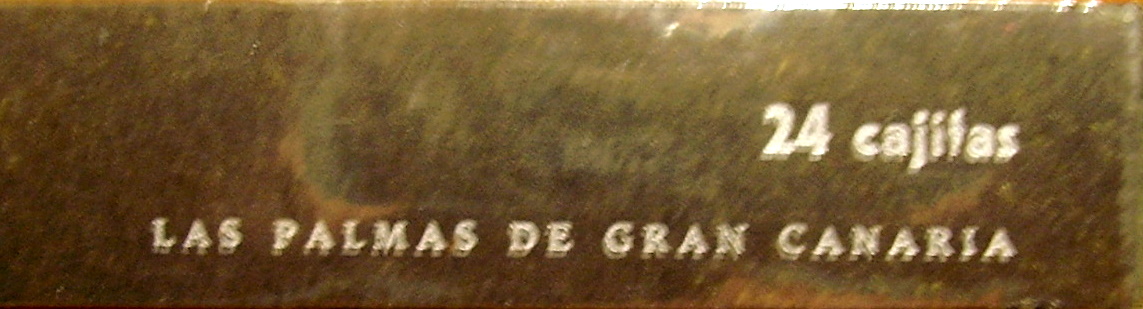
A defunct (?) match factory in Las Palmas (capital city of Gran Canaria), Fosforera Canariense, produced this nice set of 24 matchboxes sometime last century after its foundation in 1935. Information regarding such items is hard to come by, on-and-offline, therefore not much more is known at this stage.

click on image for large version
The set is called Caracolas Marinas (marine snails) and features 24 species of molluscs (inexplicably consisting of one bivalve and 23 predominantly tropical, not-all-marine, gastropods) heavily inked onto a pale blue background. The way they are packaged makes it impossible to see what is on the hidden side of each matchbox, and where, presumably, the species identifications are printed.

click on image for large version
Now, I am sorely tempted to tear open the polythene covering holding the set together in order to read them; on the other hand, doing so will detract from the neatness and value of the boxed set. I'm a stickler for 'accurate' identification (as opposed to mere Cypraea, Murex, Lambis, Harpa, Conus, Architectonica, Mitra, Cymatium etc.) but these cardboard versions will have to remain a mystery, at least until curiosity gets the upper hand.

Monday, August 1, 2011

Los Gigantes cliffs in Tenerife

The highest cliffs in the volcanic island of Tenerife, in the Atlantic Ocean, are found on its western side. These majestic geological features are known as 'Los Gigantes' (the Giants), a term which perfectly befits their massive presence.

Acantilados de Los Gigantes, Tenerife

The cliffs are (like much of the island) composed of 'alkali' basalt, a volcanic rock which contains high proportions minerals like feldspar, olivine and iron oxides. These mineral accretions are sometimes large enough to be seen with the naked eye:

feldspar (white crystals) and iron oxides (brown aggregate) in basalt

feldspar (white crystals) and iron oxides (brown aggregate) in basalt

olivine (greenish crystals) in basalt

The basalt is found in layers which are texturally highly varied, each layer indicating a different episode or process in the island's violent volcanic history. For example, the breccia-like ignimbrite forms when a stream of lava partly melts the substrate upon which it is flowing and drags the pieces of hot rock along, subsequently welding the fragments together into a pudding-like composition, in this case containing fragments of widely disparate size:

ignimbrite

Another rock which stands out visually is red ochre, which forms when hot lava passes over well-developed soils. It can be seen as a thin reddish line in the following photograph:

red ochre stratum

Over millions of years, boulders of basalt tumble down the cliffs and are rounded by wave and wind action.

boulders on the shore

As a rough habitat largely characterized by strong currents and abrasive basalt gravel, the interface between the sea and land is largely devoid of macrofauna, though some usual suspects make an appearance. Most notable of these are two Macaronesian endemics - the limpet Patella piperata Gould, 1846 and the periwinkle Littorina striata King & Broderip, 1832. Closer to mean sea level, Patella tenuis crenata d'Orbigny, 1840 makes an appearance. The third species of limpet that may be encountered on Tenerife is Patella ulyssiponensis Gmelin, 1791, though none of these were seen during this trip. 

Littorina striata King & Broderip, 1832

Littorina striata King & Broderip, 1832
Patella piperata Gould, 1846

Patella piperata Gould, 1846

Specimens of Osilinus sauciatus (Koch, 1845) were found in small clusters, mostly using deep cracks as shelter.

Osilinus sauciatus (Koch, 1845)

Saturday, May 21, 2011

New marine biology papers

1. Mifsud, C. & Cachia, C., 2011. New additions and corrections, with annotations, to the check-list of the marine Mollusca of the Maltese Islands. Triton, 23: 10-18.

This paper is an addendum to the four volumes on marine mollusc records from the Maltese Islands by Cachia, Mifsud & Sammut (1991; 1996; 2001; 2004 - see full references below). In this paper, 99 additional records are mentioned together with a number of corrections of previous records.

Of particular interest is a second species of Paludinella for Malta. This minute snail is rare and lives in marshes, and previously only Paludinella littorina (Delle Chiaje, 1828) was known to occur. Samples from Salina Bay have yielded some individuals of Paludinella sicana (Brugnone, 1876).

A comparison of Paludinella sicana (Brugnone, 1876) and Paludinella littorina (Delle Chiaje, 1828), pictures taken from the Natuurhistorisch Museum Rotterdam collection

Also worthy of mention is the first Central Mediterranean record of the pyramidellid Leucotina eva Thiele, 1925.

2. Deidun, A., Galea Bonavia, F. & Schembri, P. J., 2011. Distribution of Tylos spp. in the Maltese Islands and population dynamics of Tylos europaeus. Journal of Coastal Research, SI 57: 369-372.

Tylos is a genus of woodlice, two species of which - Tylos europaeus Arcangeli, 1938 and Tylos sardous Arcangeli, 1938 - occur on two sandy beaches on island of Gozo. This paper examines their habitat and gives an account of yearly fluctuations in the former's population.

References:

Cachia, C., Mifsud, C. & Sammut, P., 1991. The Marine Shelled Mollusca of the Maltese Islands Part 1: Archaeogastropoda. Malta: Grima Printing & Publishing Industries; 112 pp.
Cachia, C., Mifsud, C. & Sammut, P., 1996. The Marine Mollusca of the Maltese Islands, Part 2: Neotaenioglossa. Netherlands: Backhuys Publishers; 228 pp.
Cachia, C., Mifsud, C. & Sammut, P., 2001. The Marine Mollusca of the Maltese Islands Part 3: Sub-class Prosobranchia to sub-class Pulmonata, order Basommatophora. Netherlands: Backhuys Publishers; 266 pp.
Cachia, C., Mifsud, C. & Sammut, P., 2004. The Marine Mollusca of the Maltese Islands Part 4: Caudofoveata, Solenogastres, Bivalvia, Scaphopoda and Cephalopoda. Netherlands: Backhuys Publishers; 270 pp.

Friday, February 11, 2011

Species spotlight XI

Mercuria cf. similis (Draparnaud, 1805)
Xlendi, Gozo

The family Hydrobiidae is a large group of small snails with gills (not lungs) living in aquatic habitats, predominantly fresh and brackish. Four representatives are found in the Maltese Islands, the largest of which is the freshwater Mercuria cf. similis (Draparnaud, 1805)*. As a denizen of fresh water bodies, usually close to Blue Clay substrates, Mercuria is rare in Malta but rather more frequent in Gozo. Colonies graze microscopic algae growing on submerged or perennially wet overhangs, and seem to prefer running, clear water. The blue-greyish shell, large shell size and habitat distinguishes it from a similar species, Pseudamnicola moussonii (Calcara, 1841), which will be discussed in a future post.

*In taxonomy, a 'cf.' indicates uncertainty in assigning a specific epithet to a specimen. The uncertainty in this case derives from anatomical differences between Maltese Mercuria and other populations of M. similis.


Mġarr, Gozo

Sunday, February 6, 2011

Species spotlight X

Many members of the family Ferussaciidae tend to adopt subterranean or cavernicolous lifestyles. One such species may be found living in areas of clayey soil along the cliffs and beaches of Mellieħa; this is the small and elusive Hohenwartiana hohenwarti (Rossmässler, 1839), which at first glance resembles its relative Ferussacia folliculum (Gmelin, 1791).

Hohenwartiana hohenwarti (Rossmässler, 1839)
Għajn Tuffieħa, Malta

In contrast to Ferussacia, however, the elongated shell of Hohenwartiana is light and thin enough to render the internal organs clearly visible. The streamlined shape allows the animal to easily navigate around the clay fragments in which it lives. After the death of the animal, the shell turns an opaque white and disintegrates relatively quickly.

The specimen above was retrieved from clay for photographic purposes and replaced quickly. My hand in the background gives an idea of the specimen's size.

Thursday, February 3, 2011

Species spotlight IX

Tudorella melitense (Sowerby, 1847)
Xlendi, Gozo

Tudorella melitense (Sowerby, 1847) is the only snail with an operculum ('door') which is native to the Maltese Islands. Under a 'biological species definition' it may be considered to be a local variety of Tudorella sulcata (Draparnaud, 1805), which also occurs in Sicily; Pfenninger et al. (2010)*, in their work on the DNA of Tudorella, consider it a lineage which is only found in the Maltese Islands.

Għajn Tuffieħa, Malta

The shell is very variable, and may be orange, white or purple, with or without bands.

Għajn Tuffieħa, Malta

*Pfenninger, M., Véla, E., Jesse, R., Arantzazu Elejalde, M., Liberto, F., Magnin, F., Martínez-Ortí, A., 2010. Temporal speciation pattern in the western Mediterranean genus Tudorella P. Fischer, 1885 (Gastropoda, Pomatiidae) supports the Tyrrhenian vicariance hypothesis. Molecular Phylogenetics and Evolution, 54: 427-436.

Thursday, January 27, 2011

Species spotlight VIII

Oxychilus draparnaudi (Beck, 1837)
Buskett, Malta

Today's featured species is a small to medium-sized snail characterized by a brown, glossy and rather flat and fragile shell. It inhabits damp substrates such as compost or leaf litter in gardens or the compact soil beneath stone boulders. The animal is a distinctive blue-grey and is an active predator on other snails.

Oxychilus is a highly speciose genus distributed throughout Europe and the Near East.

Pembroke, Malta

Sunday, January 23, 2011

Tuesday, January 18, 2011

Species spotlight VII

Eobania vermiculata (Müller, 1774)
Żurrieq, Malta

The steppe areas of Malta are frequently populated by large snails from the family Helicidae, amongst which this species, Eobania vermiculata, commonly prevails. The shape and pattern of the shell is highly variable. In Malta, this is not a species utilized for food, unlike in the rest of Europe.

Rabat, Malta

Shell identification:
  • large thick shell
  • white base colour
  • frequently banded
  • flared lip

Thursday, January 13, 2011

A contribution to 'Sagħtar'

Sagħtar is a students' magazine in its 37th year of publication. This month's issue includes information on some snails found in the Majjistral Nature & History Park. This article was written by Annalise Falzon from Nature Trust Malta and features a couple of my photographs. (click on image to view in full size)


Wednesday, January 12, 2011

Species spotlight VI

Xerocrassa meda (Porro, 1840)
Santa Venera, Malta

One of the commonest snails in Maltese gardens is this medium-sized species that apparently does not mind living in human-influenced habitats, actually preferring cultivated patches to the Mediterranean garigue so beloved of its other relatives. It might have originally been a Maltese and South-Sicilian endemic, eventually spreading to other Mediterranean islands by human intervention.


X. meda is one of two species in the genus Xerocrassa in Malta, which is sometimes treated as a synonym of Trochoidea, but which actually presents anatomical differences from that genus and is herein treated separately following the AnimalBase entry.

Shell identification

  • 6-8mm
  • pale brown or cream colour with darker bracket-shaped stripes
  • aperture with a slight pinkish colour
  • umbilicus pin-point shaped

Tuesday, January 11, 2011

Species spotlight V

Deroceras panormitanum (Lessona & Pollonera, 1882)
Żejtun, Malta

This is another slug described by the same folks who named yesterday's featured species. It is a south-west Mediterranean species which has since spread to most of Europe, North America and elsewhere. It can be distinguished from other Maltese slugs by its chestnut-pink colour, smaller size (about 2-3cm) and a fingerprint-like pattern on its back. A very similar species, Deroceras golcheri Regteren Altena, 1962 is endemic to Malta but is much rarer, and in places where it occurs with D. panormitanum, differences in colour and size are constant and consistent. D. golcheri also has a black mark near its pneumostome (respiratory opening, visible in both pictures) which D. panormitanum lacks.

Deroceras also has an internal shell.


Pictures are of the same individual.

Identification
  • small fast-moving slug
  • pinkish or pale brown
  • mucus transparent
  • fingerprint pattern on back
  • no black mark near respiratory opening

Monday, January 10, 2011

Species spotlight IV

Lehmannia melitensis (Lessona & Pollonera, 1882)
Mdina, Malta

Lehmannia melitensis (Lessona & Pollonera, 1882) is a slug and thus appears shell-less, though a thin shell called limacella is present inside the body of the animal. This slug seems to be prevalent in the areas from Ta' Qali up to Rabat and varies from very light grey to almost black. It is similar to another more common slug called Milax nigricans (Philippi, 1836), which, however, has an angled dorsal side.

Lehmannia melitensis (Lessona & Pollonera, 1882)
Buskett, Malta

L. melitensis is distributed throughout Malta, Sicily, Sardinia and other places. Maltese specimens are usually greyer than those from other places. More information on this species and its congener Lehmannia valentiana (Férussac, 1822) may be found here.

Identification
  • grey or black
  • dark stripes running along its upper body
  • fingerprint pattern on back
  • rounded back

Sunday, January 9, 2011

Species spotlight III

Lampedusa imitatrix (Böttger, 1879)
Mtaħleb, Malta

The clausiliid genus Lampedusa is endemic to Malta and the island of Lampedusa. In Malta it consists of two species, both of which are restricted in occurrence and live solely in highly calcareous habitats. The long and thin shell is characteristic of the family to which these snails belong. The picture shows a group of Lampedusa imitatrix (Boettger, 1879) individuals aestivating in Mtaħleb together with one (distant) relative - Cantareus aspersus (Müller, 1774). The other Maltese congener Lampedusa melitensis (Caruana Gatto, 1892) will be encountered later; while the third and final species Lampedusa lopadusae (Calcara, 1846), endemic to another Mediterranean island, is the subject of this post.

Baħrija, Malta

Shell identification
  • long and narrow shell
  • shell top not broken
  • ribbed
  • more than two incomplete ribs on last whorl
  • shell tapers down near opening

Thursday, January 6, 2011

The rediscovery of Gibbula nivosa

The best known marine snail endemism in the Maltese Islands is certainly Gibbula nivosa Adams, 1851 - in vernacular, this is the Maltese Topshell. This mollusc was previously known in a 'live setting' only from St. Thomas' Bay in Marsaskala, with the ever-increasing scarcity of live individuals leading some authors to speculate on its extinction.

A paper published last November, however, sets the record straight - G. nivosa is alive and kicking (albeit in a critically endangered manner) in two localities around the Maltese Islands. You can read the original abstract here and a synopsis here.

Gibbula nivosa Adams, 1851
on a 1979 stamp

Tuesday, January 4, 2011

A walk around the Colosseum


The Amphitheatrum Flavium, better known as the Colosseum, is an iconic Roman era building in the centre of Rome. Ravaged by natural phenomena and looters throughout the centuries, it still stands towering above the city, and offers a wonderful opportunity to admire the architectural and engineering prowess of the ancient Romans.

In 1643, far before the advent of Linnaean taxonomy, a gent by the name of Domenico Panaroli decided to publish an inventory of the plants found inside the Colosseum after noticing several exotic (mainly North African) species inside and around it, resulting in the tome Plantarum Amphytheatralium Catalogus. Nowadays, the list of species from the Colosseum has grown to 684 species of plants (Caneva, 2003).

A humidity-loving moss, bearing sporangia (fruiting bodies) on stalks

Adiantum capillusveneris L., also found in Malta

Cymbalaria muralis G. Gaertn., B. Mey. & Scherb.

Of course, the ample vegetation offers much cover for my favourite invertebrates - snails. The most common ones present in soil were Eobania vermiculata (Müller, 1774) and a species of Cernuella (I have not yet decided which this is out of the confusing trio of C. virgata (Da Costa, 1778), C. cisalpina (Rossmässler, 1837) and C. neglecta (Draparnaud, 1805)). Later on, a few specimens of Papillifera bidens (Linnaeus, 1758) and Xerotricha apicina (Lamarck, 1822) were encountered amongst the ruins.

Cernuella sp.

Xerotricha apicina (Lamarck, 1822)

On a totally unrelated note, here's one of the modern day inhabitants of the Colosseum:


References:

Caneva, G., 2003. The Colosseum's use and state of abandonment as analysed through its flora. International Biodeterioration & Biodegradation, 51: 211-219.
Panaroli, D., 1643. Jatrologismi sive medicae observationes quibus additus est in fine Plantarum Amphytheatralium Catalogus. Typis Dominici Marciani, Rome.
Related Posts Plugin for WordPress, Blogger...