Showing posts with label maltese islands. Show all posts

Tuesday, January 17, 2012

Entomological Society of Malta - vol. 4 launch

Last Friday saw the launch of the 4th volume of ESM's excellent series of papers dealing with, as the name of the society implies, the entomology of the Maltese islands and their biogeographic context.

The event was held under the patronage of His Excellency Dr. George Abela, and three society members (including its chairman) delivered short speeches on the importance of scientific research, peer reviews, funding and the maintenance of high publication standards. 


The scope of the talks ranged from the general, all-encompassing importance of works by luminaries such as Max Planck and Thomas Kuhn, to the specialized methodologies employed by scientists dealing in what the public may perceive as the "dinja stramba ta' dud, nemel u nsetti oħra" (lit. strange world of bugs, ants and other insects).

On to the main issue at hand - and its contents. This collection contains:

1) a catalogue of the aphid species occurring in Malta, with 48 new records, together with a list of aphid parasitoids, with three new records, and a new record of a coccid
2) observations and records of tachinid, rhinophorid and cecidomyiid flies from Malta and other Mediterranean areas
3) observations and records of nepticulid and pyralid moths from Malta
4) a catalogue of Maltese Scarabeoidea with eight new records, with a discussion on possible extinction mechanisms for these very interesting beetles
5) short features aimed at the younger demographic

A sample illustration - Scarabaeus (Ateuchetus) semipunctatus Fabricius, 1792 and Scarabaeus (Ateuchetus) variolosus Fabricius, 1787

The website was not updated in time for the launch, therefore for more information on the society please contact

Dr. David Mifsud
Entomological Society of Malta
P. O. Box 9
Marsa, MRS1000
Malta

Thursday, January 12, 2012

Death of a Phoenix

Palms are a common sight in Malta, with the warm temperatures affecting the islands throughout most of the year being a perfect catalyst for their growth and proliferation. This said, indigenous species amount to just one - the low-growing, bushy Chamaerops humilis L., now practically extinct in the wild.

Chamaerops humilis L., photographed by Aron Tanti

The recent invasion of the red palm weevil Rhynchophorus ferrugineus (Olivier, 1790) has affected several of the ornamental palms of the genus Phoenix.

Rhynchophorus ferrugineus (Olivier, 1790) from www.cm-oaz.pt
 
The date palm, Phoenix dactylifera L., is a historically important North African species that may be distinguished by leaves arranged in wide silvery fronds. The picture beneath shows this species of palm affected by the Rhynchophorus beetle.

Phoenix dactylifera L. affected by the red palm weevil in Santa Venera, Malta

Phoenix sp. in Rome, Italy, with the one on the right showing symptoms of red palm weevil infestation

Phoenix canariensis Chabaud is a Canarian endemic which is frequently planted around the Mediterranean, not least in Malta. Unfortunately it is also affected by the weevil in question and several stately specimens from around the island have been destroyed.

Phoenix canariensis Chabaud in the main road of Floriana, Malta

The inhabitants of Tenerife certainly make excellent use of their endemic palm species!

Saturday, May 21, 2011

New marine biology papers

1. Mifsud, C. & Cachia, C., 2011. New additions and corrections, with annotations, to the check-list of the marine Mollusca of the Maltese Islands. Triton, 23: 10-18.

This paper is an addendum to the four volumes on marine mollusc records from the Maltese Islands by Cachia, Mifsud & Sammut (1991; 1996; 2001; 2004 - see full references below). In this paper, 99 additional records are mentioned together with a number of corrections of previous records.

Of particular interest is a second species of Paludinella for Malta. This minute snail is rare and lives in marshes, and previously only Paludinella littorina (Delle Chiaje, 1828) was known to occur. Samples from Salina Bay have yielded some individuals of Paludinella sicana (Brugnone, 1876).

A comparison of Paludinella sicana (Brugnone, 1876) and Paludinella littorina (Delle Chiaje, 1828), pictures taken from the Natuurhistorisch Museum Rotterdam collection

Also worthy of mention is the first Central Mediterranean record of the pyramidellid Leucotina eva Thiele, 1925.

2. Deidun, A., Galea Bonavia, F. & Schembri, P. J., 2011. Distribution of Tylos spp. in the Maltese Islands and population dynamics of Tylos europaeus. Journal of Coastal Research, SI 57: 369-372.

Tylos is a genus of woodlice, two species of which - Tylos europaeus Arcangeli, 1938 and Tylos sardous Arcangeli, 1938 - occur on two sandy beaches on island of Gozo. This paper examines their habitat and gives an account of yearly fluctuations in the former's population.

References:

Cachia, C., Mifsud, C. & Sammut, P., 1991. The Marine Shelled Mollusca of the Maltese Islands Part 1: Archaeogastropoda. Malta: Grima Printing & Publishing Industries; 112 pp.
Cachia, C., Mifsud, C. & Sammut, P., 1996. The Marine Mollusca of the Maltese Islands, Part 2: Neotaenioglossa. Netherlands: Backhuys Publishers; 228 pp.
Cachia, C., Mifsud, C. & Sammut, P., 2001. The Marine Mollusca of the Maltese Islands Part 3: Sub-class Prosobranchia to sub-class Pulmonata, order Basommatophora. Netherlands: Backhuys Publishers; 266 pp.
Cachia, C., Mifsud, C. & Sammut, P., 2004. The Marine Mollusca of the Maltese Islands Part 4: Caudofoveata, Solenogastres, Bivalvia, Scaphopoda and Cephalopoda. Netherlands: Backhuys Publishers; 270 pp.

Friday, May 20, 2011

Endangered Species Day 2011

On the occasion of Endangered Species Day 2011, I present one of the most characteristic floral endemics of Malta, namely the Maltese Everlasting (Helichrysum melitense). This plant grows on the cliffs of Dwejra (Gozo) and Fungus Rock, and is most probably extinct in the wild from Malta. The remnants of the population are threatened by quarrying (mostly illegal), dumping of construction materials, alien species and habitat deterioration.

Helichrysum melitense (Pignatti), Dwejra - Għawdex, 21.VI.2008

Friday, February 11, 2011

Species spotlight XI

Mercuria cf. similis (Draparnaud, 1805)
Xlendi, Gozo

The family Hydrobiidae is a large group of small snails with gills (not lungs) living in aquatic habitats, predominantly fresh and brackish. Four representatives are found in the Maltese Islands, the largest of which is the freshwater Mercuria cf. similis (Draparnaud, 1805)*. As a denizen of fresh water bodies, usually close to Blue Clay substrates, Mercuria is rare in Malta but rather more frequent in Gozo. Colonies graze microscopic algae growing on submerged or perennially wet overhangs, and seem to prefer running, clear water. The blue-greyish shell, large shell size and habitat distinguishes it from a similar species, Pseudamnicola moussonii (Calcara, 1841), which will be discussed in a future post.

*In taxonomy, a 'cf.' indicates uncertainty in assigning a specific epithet to a specimen. The uncertainty in this case derives from anatomical differences between Maltese Mercuria and other populations of M. similis.


Mġarr, Gozo

Thursday, February 3, 2011

Species spotlight IX

Tudorella melitense (Sowerby, 1847)
Xlendi, Gozo

Tudorella melitense (Sowerby, 1847) is the only snail with an operculum ('door') which is native to the Maltese Islands. Under a 'biological species definition' it may be considered to be a local variety of Tudorella sulcata (Draparnaud, 1805), which also occurs in Sicily; Pfenninger et al. (2010)*, in their work on the DNA of Tudorella, consider it a lineage which is only found in the Maltese Islands.

Għajn Tuffieħa, Malta

The shell is very variable, and may be orange, white or purple, with or without bands.

Għajn Tuffieħa, Malta

*Pfenninger, M., Véla, E., Jesse, R., Arantzazu Elejalde, M., Liberto, F., Magnin, F., Martínez-Ortí, A., 2010. Temporal speciation pattern in the western Mediterranean genus Tudorella P. Fischer, 1885 (Gastropoda, Pomatiidae) supports the Tyrrhenian vicariance hypothesis. Molecular Phylogenetics and Evolution, 54: 427-436.

Wednesday, January 26, 2011

Thursday, January 6, 2011

The rediscovery of Gibbula nivosa

The best known marine snail endemism in the Maltese Islands is certainly Gibbula nivosa Adams, 1851 - in vernacular, this is the Maltese Topshell. This mollusc was previously known in a 'live setting' only from St. Thomas' Bay in Marsaskala, with the ever-increasing scarcity of live individuals leading some authors to speculate on its extinction.

A paper published last November, however, sets the record straight - G. nivosa is alive and kicking (albeit in a critically endangered manner) in two localities around the Maltese Islands. You can read the original abstract here and a synopsis here.

Gibbula nivosa Adams, 1851
on a 1979 stamp

Monday, December 20, 2010

Scales in stone

From the 12th of this December to the 16th of January 2011, Heritage Malta is organizing an exhibition on fossil fish from the Maltese Islands at the National Museum of Natural History (NMNH) in Mdina.


Such remains are of high importance, both palaeontologically and historically, being featured in several scientific publications including palaeoecological studies and new taxonomic descriptions. Most are also extremely rare, with fragile bones that do not fossilize easily.

To whet appetites, here's a taster of what the NMNH collection of fossil fish includes:

Stereodon melitensis Owen, 1864

Myliobates sp.

Holocentrum melitense Woodward, 1887

Friday, December 17, 2010

Islands of the Maltese Archipelago - Part I

Filfla
Southermost island of the Maltese Archipelago

General's Rock
Westernmost island of the Maltese Archipelago

Wednesday, December 15, 2010

Entomological Society of Malta - vol. 3 launch

The launch of the annual third volume of papers in the excellent series by the Entomological Society of Malta took place this evening at the sumptuous Casino Maltese in Valletta. The occasion consisted of short talks and a presentation on what is included in this journal, entitled Bullettin of the Entomological Society of Malta.


The contents of this issue are:
1) A first Maltese record of a non-pollinating wasp of Ficus sp.
2) A review of the tineid moths from Malta including the description of a new species - Euthria melitensis Gaedike & Zerafa, 2010
3) A review of the Maltese Heteroptera with seven new records
4) A survey of potentially disease-carrying mosquito species in Malta
5) A review of the weevils of the Maltese Islands with 51 new records
6) A section aimed at young entomologists

Another moth was described in the second issue of the journal from 2009; this was Stichobasis postmeridianus, shown below. Both are, as far as is known, endemic species.

Stichobasis postmeridianus Zerafa & Sammut, 2009

For information on how to obtain Volume 3 or any of the previous ones please contact:

Entomological Society of Malta
P. O. Box 9

Marsa MRS1000

Malta

Saturday, October 9, 2010

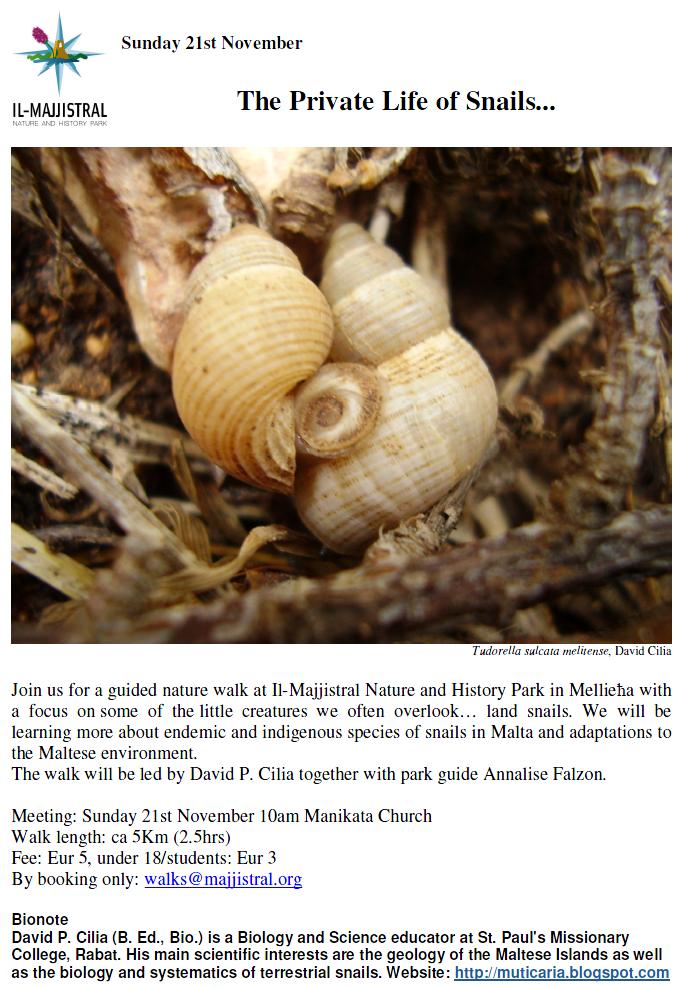
The private life of snails


This event is happening at the Majjistral Nature and History Park on the 21st of November. Please click on the picture for a better view!

Friday, August 27, 2010

Scorpion, interrupted


I (unintentionally) interrupted this scorpion at Għajn Tuffieħa while it was feasting upon the remains of a fellow arthropod - a hapless woodlouse, which can be seen still attached to the scorpion's jaws in the lower picture. A few seconds after being discovered, the scorpion released the morsel and assumed a compact, defensive stance, remaining utterly immobile until yours truly decided to leave it in peace and restore its stony hideout to its original place.

Only this species of scorpion exists in Malta. It is the small Euscorpius sicanus (Koch, 1837), also found on other Mediterranean islands.

Thursday, August 12, 2010

Dissertation - A student’s guide to the geology of the Maltese Islands

The citation and abstract to my B. Ed. (Hons) dissertation have been added to the links on the right-hand side of this blog. The page can also be accessed through here.

Monday, June 14, 2010

A lepidopteran pit stop

A frequent migrant in June is the elegantly-named butterfly Vanessa (Cynthia) cardui (L., 1758), passing over Malta from North Africa on the way to cooler European climates. The following pictures, taken yesterday in Santa Venera, show a very small sample of hundreds of individuals feeding on the nectar of cultivated plants, before continuing their journey. They seem to prefer the Lantana shrubs above anything else, though this may be because of the flowers' bright yellow colour - purple-flowered Lantana shrubs were hardly visited.


Friday, May 28, 2010

Variations on a theme, Part IV

The most common invasive plant in the Maltese countryside is the Cape Sorrel (Oxalis pes-caprae L.). The pictures below, taken at Għajn Tuffieħa, show the usual variety of the flower (1), together with another less frequent form exhibiting extra petals (2) resulting from additional sets of chromosomes in the cells' nucleus (polyploidy).

It is known for its sour taste resulting from a reserve of oxalic acid in the plant tissues, which has also resulted in its Maltese vernacular name of Qarsu (=sour).

(1)

(2)

Monday, May 24, 2010

The 'Scutella Bed'

Specimen of Scutella subrotunda (Leske, 1778) from the British Natural History Museum, E16593

Leske's original description of the sea-urchin Scutella subrotunda, 1778


The rocks of the Maltese Islands formed beneath the sea in the period spanning from the late Oligocene to the late Miocene, from 28 to 5 million years ago.

By looking at the rocks and the fossils they contain, it is possible to deduce which kind of environment existed all those years ago, by comparing them to present marine habitats and environments.

The Lower Coralline Limestone (known in Maltese as Żonqor) is the first exposed rock of the islands. It was the first to form, 28 to 23 millions of years ago, in the Oligocene period.

Towards the end of the Oligocene, the consistency of the Lower Coralline Limestone changed considerably, passing from frequently semi-crystalline, very compact rock (Attard member) to about ten metres' thickness of relatively less rigid, coarser rock (Il-Mara member), with cross-bedding characteristics. This probably represents very suddenly shallowing water, and may suggest tectonic activity.

This changed environment meant that the seabed was now subjected to stronger currents than before, therefore waves would drag large amounts of debris from deeper waters and deposit them onto these shallow reef-like platforms nowadays called the Maltese Islands.

This debris consisted mostly of organisms and their skeletons, the most common of which was the now extinct sea-urchin Scutella subrotunda (Leske, 1778). The large calcium carbonate testas (usually fragmented, but not exclusively) of huge populations of this echinoid compose one or more layers (up to five) marking the end of the Lower Coralline Limestone phase, to the extent that they have been named 'Scutella Beds' by the British geologist T. A. B. Spratt.

Scutella Bed in Xlendi member Lower Coralline Limestone, Spinola Bay

Scutella fossil in Xlendi member Lower Coralline Limestone, Dwejra (Gozo)

References:

Leske, N. G., 1778. Additamenta ad Jacobi Theodori Klein naturalem dispositionem Echinodermatum et lucubratiunculam de aculeis echinorum marinorum. Lipsiae, Leipzig, 278 pp.
Smith, A. B. (ed.), 2005. The Echinoid Directory. [WWW document, link: http://www.nhm.ac.uk/research-curation/projects/echinoid-directory/index; last accessed: 24.V.2010]
Spratt, T. A. B., 1843. On the geology of the Maltese Islands. Proceedings of the Geological Society of London, 4 (2): 225-231.
Spratt, T. A. B., 1854. On the geology of Malta and Gozo [2nd edition]. Malta, 16 pp.

Sunday, May 9, 2010

On some fossil brachiopods from the Maltese Islands

Brachiopods are filter-feeders usually indicating seabeds densely populated with algae. The calcium carbonate shell of these animals is fragile and therefore sufficient shelter from waves is usually needed. In fact, they are mostly found in the Upper and Lower Coralline limestones.

The Il-Mâra Lower Coralline Limestone in the north-east areas of Malta occasionally contains populations of a dwarf form of Terebratula vitrea (von Born, 1778). These fragile brachiopods are usually found in association with cidaroid sea-urchin fragments and large species of foraminifers, including Heterostegina.

Terebratula vitrea (von Born, 1778)

In the westernmost parts of Malta, conspicuous 10 to 20cm thick layers of brachiopod shells are often present in cliff faces composed of the Mtarfa Upper Coralline Limestone, amongst rhodoliths and bryozoan fragments. These fossils are often crushed and identification is difficult unless the shell is broken open. Material from these brachiopod layers was used by Cooper (1983) to describe a new genus and species both named for the type locality, namely Maltaia maltensis Cooper, 1983, considered by other writers (Gaetani & Saccà, 1983) to be a synonym of Terebratula sinuosa (Brocchi, 1814). The latter is also found in considerable numbers in the same strata. However, the former species is markedly different in form and is also found in areas where ‘normal’ T. sinuosa is absent .

Terebratula sinuosa (Brocchi, 1814) (lower picture - detail)


Maltaia maltensis (Cooper, 1983) (detail)

The small (6mm) Megathiris detruncata (Gmelin, 1790) and other small species like Argyrotheca sp. are also very common throughout some parts of the Upper Coralline Limestone Formation.

Megathiris detruncata (Gmelin, 1790)

Deep sea such as that in which the Globigerina Limestone formed also offers protection from strong currents that may damage brachiopods. Despite this, brachiopods in this layer are few and far in between. Disarticulated phosphatised valves of the still-extant Megerlia truncata (Linné, 1767) are infrequently found in the C2 Phosphorite Conglomerate Bed.

Megerlia truncata (Linné, 1767)


References:


Cooper, G. A., 1983. The Terebratulacea (Brachiopoda), Triassic to Recent: a study of the brachidia (loops). Smithsonian Contributions to Paleobiology, 50: 1-445.
Emig, C. C., 2006. Brachiopoda world database. [www document, url: http://www.marinespecies.org/brachiopoda, last accessed: 10.II.2010]
Gaetani, M. & Saccà, D., 1983. Brachiopodi neogenici e pleistocenici della provincia di Messina e della Calabria meridionale. Geologica Romana, 22: 1-42.

Wednesday, March 17, 2010

New project uploaded


A small website required for a University assignment has been uploaded at the link pasted below:

Maltese Endemic Landsnails

Virtually all photographs included are appearing on the web for the first time.

The website expires this year, so I will upload the content here as soon as that occurs.

Tuesday, March 16, 2010

Back to basics

The isopods are the perfect example of crustaceans that have adapted to life in a terrestrial habitat. However, some of them have opted for a return to the aquatic world, an evolutionary move which finds parallels in other animal groups as diverse as molluscs, reptiles and mammals.

The above picture shows the woodlouse Sphaeroma sp., found beneath a rock in the Salini marshes, a unique ecosystem which features one of the very few brackish water habitats in the Maltese Islands.
Related Posts Plugin for WordPress, Blogger...